
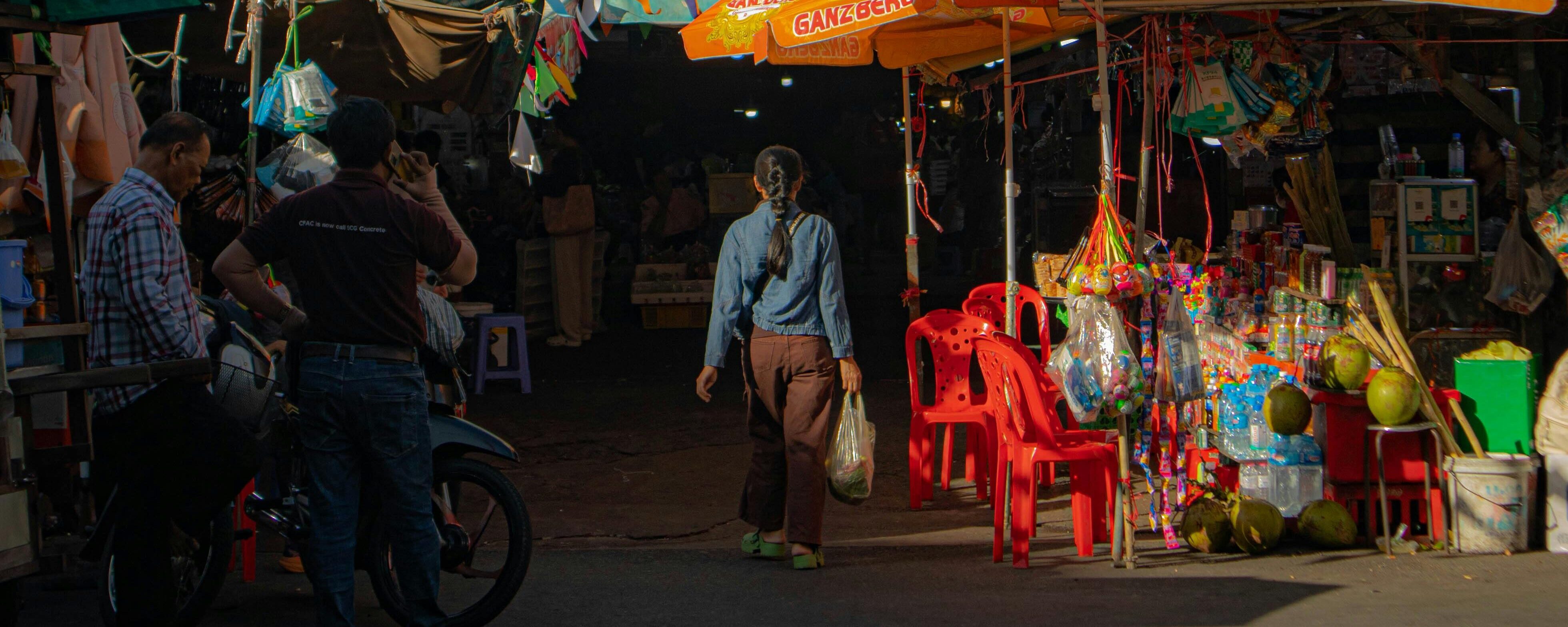
This blog is the first in a two-part series on nano-enterprises, a segment that remains underrepresented in official statistics and policy discussions. It presents a descriptive overview of India’s unincorporated enterprises using evidence from ASUSE, laying the empirical foundation for subsequent analysis focused on nano-enterprises.
India’s MSME landscape is dominated by unincorporated enterprises operating outside the formal structure. A substantial share of employment and economic activity is generated by enterprises that function without formal registration or compliance with regulatory thresholds. Informal employment accounts for around 85% of total employment in India, based on estimates from the Periodic Labour Force Survey (PLFS).[1] It plays an important role in livelihood generation, particularly among low-income households, by enabling diversified economic activities alongside other sources of income.[2]
However, much of the available evidence on Indian enterprises is derived from administrative records, tax filings, and datasets linked to government or institutional interventions. These sources primarily capture firms that are already registered or otherwise connected to formal institutions. Enterprises that function at scales where formal registration offers limited practical sense are systematically underrepresented, resulting in limited visibility for unincorporated enterprises.
Nano Enterprises
At the base of the MSME pyramid are enterprises that operate at very low levels of turnover, employ no or few workers, and remain largely outside formal regulatory frameworks. These enterprises are ubiquitous across rural and urban India, encompassing kirana stores, small textile and garment retailers, repair shops, hardware outlets, dairy activities, and a wide range of personal and household services. Most of these are referred to as nano enterprises – typically characterized by annual turnover below 1 crore, minimal hired labour, high dependence on household participation, limited capital intensity, and working capital–driven credit needs.[3] They are often cash-based, thinly capitalized, and embedded within local markets, with blurred boundaries between household and business finances.
Despite their visibility in everyday economic life, understanding how these enterprises are structured, how they perform, and how they engage with the formal financial system has remained limited. It is in this context that the Annual Survey of Unincorporated Sector Enterprises (ASUSE) provides a nationally representative source of data to examine the characteristics and functioning of these enterprises.
Annual Survey of Unincorporated Sector Enterprises
Annual Survey of Unincorporated Sector Enterprises (ASUSE) provides a critical window into India’s unincorporated enterprises. Conducted annually by the National Sample Survey Office (NSSO) since 2021, ASUSE captures non-agricultural unincorporated enterprises and provides nationally representative, unit-level data on ownership, employment, location of operation, production, turnover, assets and liabilities, access to credit, digital usage, formal registration etc., Its industry-specific financial schedules and enterprise-level institutional variables allow researchers to analyze productivity, informality, and how enterprises differ in the way they are organized, owned, and distributed across sectors, with far greater precision than most firm-level surveys.
Findings
Enterprise Landscape: Employment, Ownership, and Location
The ASUSE 2023–24 round covers 5.23 lakh sample enterprises, representing an estimated 7.7 crore unincorporated establishments across India. At the population level, 86.5% of enterprises are run solely by working owners. In contrast, 13.5% of enterprises employ hired labor, with 6.0% employing one hired worker, 5.5% employing between two and four hired workers, and 2.0% employing five or more hired workers. Total employment across unincorporated enterprises is estimated at 12.4 crore workers.
Ownership structures are predominantly individual. Proprietary enterprises account for nearly 95% of all enterprises, with 69.1% owned by men and 25.8% owned by women. Self-Help Group–based enterprises constitute 3.53%, and societies, trusts, associations, and other membership-based organizations together account for 0.74% of enterprises.
The location of enterprise operations varies across different types of premises. 40.8% of enterprises operate within household premises, while 37.2% operate from fixed premises with permanent structures outside the household. Enterprises operating from fixed premises with temporary structures such as kiosks or stalls account for 2.1%, while 2.7% operate from fixed premises without any structure. Mobile market operations account for 2.2%, and 15.1% of enterprises operate without fixed premises, including street vendors.
80.0% of enterprises report operating for more than three years, 15.8% report operating for one to three years, and 4.1% have been operating for less than one year. Seasonal or casual enterprises constitute a very small share of the total enterprise.
Turnover Distribution
Turnover, i.e., total receipts from the sales of goods or services data from ASUSE show that enterprise activity is concentrated at lower turnover levels. 81.6% of enterprises report annual turnover below ₹10 lakh, while 12.2% report turnover between ₹10 lakh and ₹25 lakh. A further 3.6% of enterprises report turnover in the ₹25–50 lakh range, and 1.6% operate between ₹50 lakh and ₹1 crore, bringing the cumulative share of enterprises with revenue below ₹1 crore to 98.9%.
Enterprises reporting turnover above ₹1 crore account for 1.1% of the total, including 0.8% in the ₹1–3 crore range, 0.1% in the ₹3–5 crore range, and 0.15% reporting turnover above ₹5 crore.
| ENTERPRISES BASED ON TURNOVER | |||
| Turnover | Number of Enterprises | Percentage | Cumulative Percentage |
| Below 10 lakh | 62,948,346 | 81.61% | 81.61% |
| 10-25 lakh | 9,395,010 | 12.18% | 93.79% |
| 25-50 lakh | 2,777,493 | 3.60% | 97.39% |
| 50 lakh-1 Cr | 1,192,306 | 1.55% | 98.94% |
| 1-3 Cr | 616,342 | 0.80% | 99.74% |
| 3-5 Cr | 88,570 | 0.11% | 99.85% |
| Above 5 Cr | 115,578 | 0.15% | 100.00% |
| Total | 77,133,645 | 100% | |
Formal Registration, Financial Access, and Digital Usage
ASUSE data indicate that 36.2% of enterprises report having at least one form of registration under any Act or regulatory authority. Registration details are captured through multiple-response categories, allowing enterprises to report more than one type of registration. Across all enterprises, 20.3% reports registration under the Shops and Establishment Act. Registrations under “any other Act” account for 32.7%, while 1.5% report registration under the Societies Registration Act, 0.7% under the Co-operative Societies Act, 0.6% under the Indian Trust Act, and 2.0% under clubs, associations, or bodies of individuals.
In addition, enterprises report other forms of registration and licenses. These include state or local body licenses (20.2%), Regional Transport Office registrations (11.0%), GST registration (2.1%), FSSAI registration (2.1%), and registration on the Udyam portal (0.44%). Also, a small share of enterprises report registrations under District Supply and Marketing Societies, KVIC/Handloom/Handicraft bodies, Directorates of Industries, commodity boards, and other miscellaneous authorities.
Formal bookkeeping practices are limited as only 0.87% of enterprises report maintaining audited books of accounts. In terms of financial access, 75.7% of enterprises report having a bank account, either in the name of the owner or the enterprise. 26.2% of enterprises report using the internet, while 5.5% report using computers in their operations.
Credit Access and Sources
Enterprises reporting outstanding loans constitute roughly 10% of the unincorporated enterprise population, amounting to approximately 78 lakh establishments at the population level. The total outstanding loan across these enterprises is estimated at ₹3.98 lakh crore, with an average outstanding loan of approximately ₹5.08 lakh per borrowing enterprise.
Among borrowing enterprises, 61.6% report having loans from formal sources, 40.7% report borrowing from informal sources, and 2.2% report borrowing from both formal and informal channels.
The distribution of loan sizes indicates substantial variation across enterprises. Among borrowing enterprises, 14.2% have outstanding loans of ₹10,000 or less, 26.1% fall in the ₹10,001–50,000 range, and 29.1% report loans between ₹50,001 and ₹2 lakh. A further 25.5% have outstanding loans between ₹2 lakh and ₹10 lakh, while 5.1% report loans exceeding ₹10 lakh.
Limitation of ASUSE
A major gap in India’s enterprise data lies in the way the Annual Survey of Unincorporated Sector Enterprises (ASUSE) captures the informal non-farm sector. While ASUSE remains the primary statistical source on unincorporated MSMEs, it may provide only a partial picture of enterprises that have undergone some degree of formalisation, particularly those registered under GST or on the Udyam portal. For instance, administrative records indicate that Udyam registrations have crossed 4.5 crore enterprises, whereas only a very small share of enterprises in ASUSE report such registrations. This suggests a divergence between administrative databases, which reflect increasing formalisation, and survey-based evidence, which continues to show a predominantly informal enterprise sector. Part of this divergence may arise from design features of the survey itself. ASUSE relies on establishment-based enumeration and household-linked listing[4], and information on registrations is self-reported. Limited integration with administrative databases such as GST and Udyam may also contribute to differences between survey and administrative estimates.[5]
Beyond issues of administrative divergence, it has also been noted that there are structural challenges in measuring the informal economy through establishment surveys. Informal enterprises often function within fluid livelihood systems marked by seasonality, intermittent activity, and movement between self-employment and wage labour. A cross-sectional annual survey may capture enterprises as discrete and stable units even when economic participation is episodic or contingent on household circumstances.[6] In addition, a significant share of informal production operates through subcontracted supply chains, home-based work arrangements, and intermediary-linked networks that are relational rather than standalone establishments. Such networked and embedded production structures are not always fully observable within establishment level survey frameworks, potentially limiting the ability to capture the full economic organization of informal activity.[7]
Addressing Data Gaps
Given the limitations, improving the availability and interoperability of alternative public data sources is essential. Administrative datasets such as Udyam have the potential to complement survey evidence but currently provide only limited public information – typically enterprise name, type, and location – restricting deeper analysis. Making richer administrative datasets available in anonymized and research-friendly formats would enable meaningful triangulation across sources.
At the same time, newer technology enabled approaches can supplement traditional surveys. These include web-scraping of e-commerce platforms to approximate the scale and activity of digitally operating enterprises,[8] the use of anonymized and aggregated merchant-level transaction data from Payment System Operators to track enterprise activity in near real time,[9] and spatial analysis of business density using Points of Interest data from platforms such as Google Maps and OpenStreetMap.[10] Together, these approaches can complement survey data by offering more timely and granular signals on enterprise activity and its organization.
The part two of the series is here.
——
[1] Pritam Ranjan Sahu and Deepak Kumar Behera, “Assessing the Nature and Determinants of Informal Employment in India,” Journal of Social and Economic Development (2025), https://link.springer.com/article/10.1007/s44282-025-00239-9
[2] Barbara Harriss-White, “India’s Informal Sector: The Feeder Economy Within,” The Hindu Centre for Politics and Public Policy, October 29, 2024, https://www.thehinducentre.com/the-arena/current-issues/indias-informal-sector-the-feeder-economy-within/article68786567.ece
[3] Misha Sharma and Navaneeth M. S., “Financing the Unseen: Blended Finance for Nano Enterprises,” Dvara Research, September 22, 2025, https://dvararesearch.com/financing-the-unseen-blended-finance-for-nano-enterprises
[4] ASUSE follows an establishment-based enumeration approach in which enterprises are identified through household-linked listing and surveyed as separate operational units. This method may undercount enterprises operating from commercial premises not captured in household listings and may treat multi-location or networked enterprises as separate units. As a result, enterprise counts and registration status may differ from administrative databases that are based on firm-level registration records.
[5] Ajit Ranade and Kiran Limaye, “Data Upgrade: How to Get an Accurate Picture of India’s MSME Sector,” Mint, August 11, 2025, https://www.livemint.com/opinion/online-views/msme-india-udyam-gst-exports-employment-gdp-credit-digital-policy-manufacturing-us-economy-tariffs-recession-technology-11754809244904.html
[6] Barbara Harriss-White, “India’s Informal Sector: The Feeder Economy Within,” The Hindu Centre for Politics and Public Policy, October 29, 2024, https://www.thehinducentre.com/the-arena/current-issues/indias-informal-sector-the-feeder-economy-within/article68786567.ece
[7] Amit Singh Khokhar, “Bridging Data Gaps: Can ASUSE Address Enterprise Data Challenges?” Economic & Political Weekly, August 16, 2025, Bridging Data Gaps in ASUSE to Address the Enterprise Formalisation Challenge | Economic and Political Weekly
[8] United Nations Conference on Trade and Development (UNCTAD), “Chapter 5 – Data Sources and Data Collection Methods,” in Manual for the Production of Statistics on the Digital Economy 2020 (United Nations, 2021), https://unctad.org/system/files/official-document/dtlstict2021d2_en.pdf
[9] Mastercard, “SpendingPulse,” dataset, accessed March 9, 2026, https://tei.forrester.com/go/Mastercard/SpendingPulse/
[10] Zhe Wang, Jianghua Zheng, Chuqiao Han, et al., “Exploring the Potential of OpenStreetMap Data in Regional Economic Development Evaluation Modeling,” Remote Sensing 16, no. 2 (2024): 239, https://doi.org/10.3390/rs16020239