
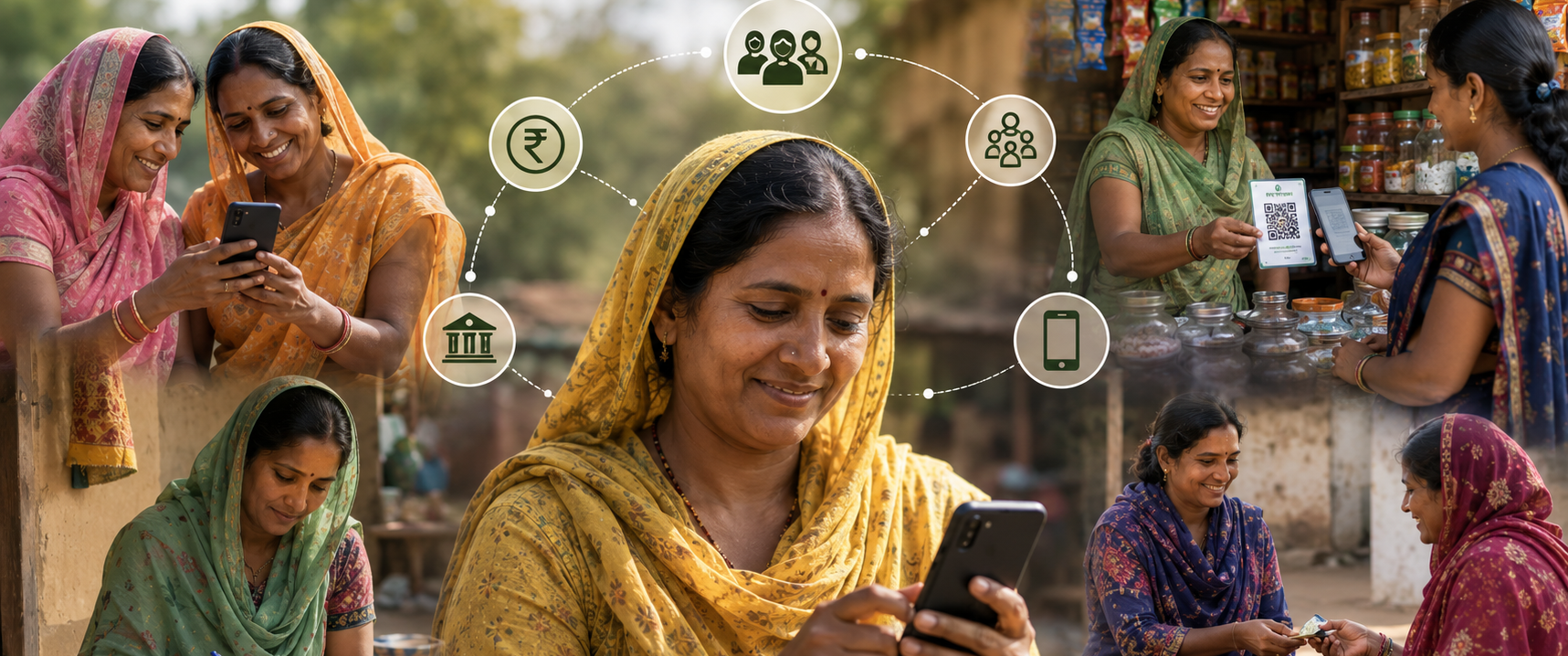
In India, digital financial services (DFS) have significantly improved access to formal financial infrastructure. Yet sustained use of these services among low-income households remains uneven. A growing body of evidence suggests that access alone is insufficient; adoption depends on the extent to which DFS align with the pre-existing financial practices of the households they seek to serve. The Digitising Women’s Money Management study was undertaken against this backdrop to understand how women in low-income households manage money, the mental models that underpin their transactions, and the extent to which these practices are amenable to digitisation.
The study followed 293 women in rural Rajasthan over 6 months, documenting more than 135,000 financial transactions while introducing assisted access to a UPI-based mobile payments application through community-based women facilitators. By observing not only what women did but also why they did it, the study sought to develop a richer understanding of household money management and its implications for digital financial services.
The study is premised on the observation that the financial lives of low-income households are characterised by radical uncertainty. Additionally, the insufficiency, instability, and illiquidity of incomes underpin household financial management. The study then draws on the literature on money management practices (MMPs) developed by Mas and Murthy (2017) to interpret the mental models and routines that households use to simplify financial decision-making. The report interprets these routines through three MMPs: income shaping, through which households influence the timing and composition of income to meet expenditure; liquidity farming, through which they cultivate social and commercial relationships that provide liquidity during periods of need; and animating money, through which resources are assigned specific purposes to protect them from competing claims. These provide the conceptual framework through which respondents’ transactions are examined and through which the interaction between existing financial practices and digital financial services is understood.
The study found that women occupy an active role in the financial management of low-income households. Across more than 135,000 observed transactions, respondents actively coordinated household cash flows, managed anticipated and unanticipated expenditure (both regular and irregular), mobilised resources during periods of financial stress, and maintained the relationships through which financial support became available. These responsibilities were evident irrespective of whether respondents were earning members of the household.
Among the three MMPs, liquidity farming emerged as the dominant practice. Respondents routinely relied on networks of family members, neighbours, village members, shopkeepers, employers, and other familiar counterparties to manage both anticipated and unanticipated expenditure. Each transaction, therefore, served a purpose beyond the immediate movement of money. Everyday transfers, purchases, borrowing, lending, and reciprocal exchanges simultaneously sustained relationships that later functioned as sources of liquidity. The findings suggest that financial relationships constitute an integral component of household financial management rather than mere channels for the flow of money.
The study further found that the introduction of digital financial services largely reinforced, rather than displaced, existing practices. Most respondents adopted UPI when provided with assisted access, but digital payments generally migrated existing financial behaviour rather than transforming it. Digital transactions enabled respondents to extend financial interactions to relatives and family members living outside the immediate household, expanding the geographical reach but continuing to leverage existing relational networks and their underlying logic. Rather than altering the MMPs that households rely on, digitisation primarily provided an additional channel for expressing such practices.
These findings have important implications for how women’s economic empowerment is understood. Existing literature largely explains women’s bargaining power through individual economic resources such as labour market participation, asset ownership, and access to formal financial institutions. While these dimensions remain important, the study’s findings suggest that they do not adequately capture the role played by women respondents within low-income households. Women respondents’ influence over household financial decisions frequently derived from their management of uncertainty, their cultivation of reciprocal relationships, and their ability to ensure that resources became available when required. Agency therefore emerged not only through independent control over resources but also through the management of the social and financial relationships that made household resilience possible.
The report consequently argues that financial management may be understood as the production of resilience. Under conditions of radical uncertainty, managing household finances extends beyond allocating existing resources to encompass the continuous work of creating, preserving, and mobilising them. This perspective also suggests a more contextual understanding of social norms. Rather than viewing norms exclusively as constraints on women’s agency, they also structure trust, reciprocal obligation, and the social relationships through which households manage uncertainty. Essentially, women can exercise agency by navigating these norms in ways that sustain household welfare.
These insights carry direct implications for the design of DFS. Formal financial products frequently assume that financial decisions are made by autonomous individuals operating exclusively in markets. The findings of this study suggest that DFS intended for low-income households should instead recognise the relational contexts underpinning financial decisions. Products that complement existing practices and strengthen established networks are likely to align more closely with users’ financial lives than those that require households to abandon long-standing practices.
Finally, the report advances two conjectures. First, digital financial services may benefit from giving greater prominence to person-to-person and relationship-oriented use cases. Second, the relational information generated through digital transactions may create opportunities for group-based financial products. While these propositions need empirical validation across different contexts, the study points towards a broader emerging principle: meaningful financial inclusion is more likely to be achieved when digital financial services are designed around the financial realities of low-income households rather than expecting households to adapt to the assumptions embedded in existing products.
Read the full report here