

On 11 September 2026, the Reserve Bank of India (RBI) released the “Draft Reserve Bank of India (Know Your Customer) Amendment Directions, 2026” (hereafter “Draft Directions”).
The Draft Directions propose a Statement of Purpose (SoP) to guide the actions of Regulated Entities (RE) when responding to suspected mule activity. They actively discourage REs from arbitrarily freezing accounts and call for restraint and proportionate interventions in response to warnings of suspicious activity.
The summary of our recommendations are below:
-
Defining mule activity independent of the Rs.1,000 threshold. Excluding the monitoring of transactions below Rs.1,000 may incentivise mule activity to cluster below that threshold to evade monitoring.
-
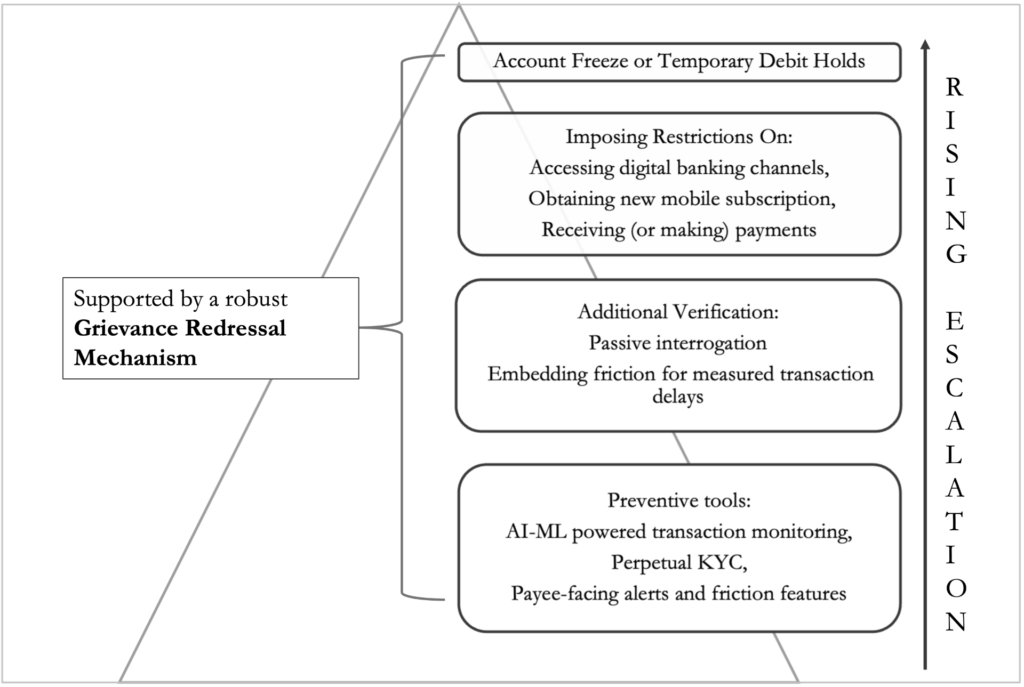
REs may consider a progressive-escalation matrix that ranks the tools available to REs, from least to most restrictive. This would help RE’s calibrate their interventions to the strength of the evidence of mule activity, the intensity of the activity, the potential harm to the customer and the system, etc. We review various instruments used by REs in India, emerging jurisprudence on account freezing and the instruments used by REs in other jurisdictions to create a progressive-escalation matrix, as depicted below:
- We recommend the SoP to institute a compensation framework to award relief in instances where banks violate the SoP or their internal policies and cause customers avoidable harm and inconvenience. Indian High Courts have awarded relief to customers where the freezing of their accounts was found disproportionate. This has already created the legal support for awarding relief to customers. Other jurisdictions compensate customers in these cases by refunding any interest or late payment fees charged when the account was dormant or by addressing any credit rating degradation due to missed or delayed loan repayments.
Read the full response here