Independent Research and Policy Advocacy

Indradeep Ghosh Dvara

Dr. Indradeep Ghosh

Executive Director
Save Author

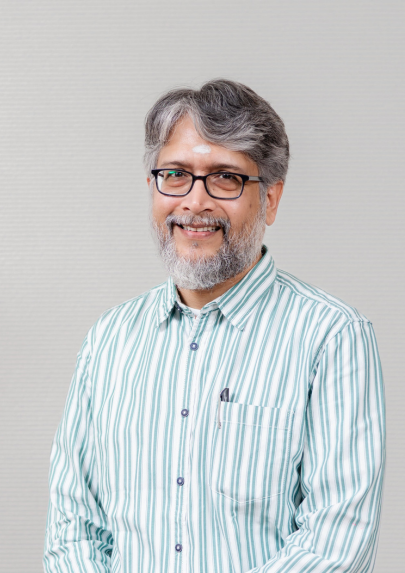
Dr. Indradeep Ghosh is the Executive Director of Dvara Research. He has a PhD from MIT, an MA from Cambridge University (where he won the Adam Smith Prize given to the top graduating student in the university), and a BA from St. Stephen’s College, all in Economics. After finishing his PhD, Dr. Ghosh pursued an academic career for more than a decade, first at Haverford College in Philadelphia, Pennsylvania, and then at the Meghnad Desai Academy of Economics in Mumbai, India. At Dvara Research, he works with the Board to drive its research agenda and leads research priorities in coordination with the practice heads.

Dr. Ghosh is a multi-disciplinary scholar and thinker, and has published his work in peer-reviewed journals in economics and other disciplines. When thinking about public policy problems, he prefers to combine his formal economics training with insights from the other social sciences and also the humanities. Dr. Ghosh interfaces regularly with policymakers and regulators to advocate for sensible pro-poor financial inclusion and social protection policies. In 2020, Dr. Ghosh led the drafting team for the Social Stock Exchange report (published by SEBI’s Working Group on the Social Stock Exchange). Currently, he is serving on SEBI’s Advisory Committee for Securities Market Inclusion Index, and on the Insolvency & Bankruptcy Board of India’s Research Guidance Group. He continues to occasionally publish in peer-reviewed journals such as the Economic & Political Weekly (see here, under Special Articles) and the Journal of Cultural Economy (see here). Recently, Indradeep has written about the relation between household level economic activity and macro-aggregate economic activity, and about women’s financial inclusion.


Focus policy initiatives

Financial Systems Design
Household Finance
Social Protection Initiative
Center For Customer Protection
The Future Of Finance Initiative

Follow

Contact: indradeep.ghosh@dvara.com

Filter Author's Work

  • All
  • Blogs
  • Consultation Responses
  • Opinion Editorials
  • Papers In Peer Reviewed Journals
  • Research Papers
  • Research Reports
May 25, 2026 | Dvara Research

This is Part 3 of a 3-part series on the recently released NCAER-MFIN report, "Assessing the Effectiveness of Regulated Small Borrowing in India". In this blog, we examine issues related to measurement and empirical strategy.

May 25, 2026 | Dvara Research

This is Part 2 of a 3-part series on the recently released NCAER-MFIN report, "Assessing the Effectiveness of Regulated Small Borrowing in India". In this blog, we turn to some of the broader claims advanced in the report regarding the wider benefits of microfinance and assess whether these claims hold up when situated in a broader empirical context.

May 25, 2026 | Dvara Research

This is Part 1 of a 3-part series on the recently released NCAER-MFIN report, "Assessing the Effectiveness of Regulated Small Borrowing in India" (March 2026).

May 18, 2026 | Dvara Research

In response to the public consultation, we argue that borrower over-indebtedness is a customer protection concern that must be explicitly recognised in the revised E&S Framework.

April 22, 2026 | LiveMint

Liquidity support by the Centre may offer symptomatic relief, but India’s microfinance sector needs a structural recast. Without reforms to address recurring cycles of over-lending and loan stress, another credit guarantee package will only postpone the next crisis in this fragile sector.

January 29, 2026 | Dvara Research

In the paper, we lay out a theoretical frame for thinking about microfinance crises. The theoretical frame draws from Hyman Minsky’s 1977 work on financial instability, and layers over it a cultural reasoning that recognises overlending and overborrowing as cultural traits that sometimes takes hold of microfinance markets.

October 6, 2025 | IBBI

This paper focuses on Part III of the IBC, which deals with natural persons, proprietorships, and personal guarantors for corporate debt.

September 29, 2025 | Dvara Research

The two worlds of policy research and academic research (in economics) sometimes do intersect, but for the most part, they appear to me to be quite different arenas of inquiry, with different epistemologies and types of truth claims. This blog is about those differences as I see them, having worked in both domains.

January 21, 2025 | Dvara Research

In India’s policy environment today, think tanks perform a crucial function. Where the high-intensity and daily pressure of execution and implementation leaves policymakers little time to reflect deeply on policy goals and policy design, think tanks render a valuable service by attempting to fill the gap.

December 17, 2024 | IFI Reports

This chapter emphasises the realities of the sector that create a feedback loop, where lenders are incentivised to over-lend and borrowers to over-borrow, until crisis intervenes as a necessary and often tragic correction